Research for Systems Mapping
How I Investigate Complex Topics Without Getting Lost
Research is often framed as the process of gathering information. In practice, information is abundant. The challenge is determining which information meaningfully improves understanding.
The goal of research is not to accumulate facts. The goal is to build increasingly accurate models of reality.
A useful model should:
Explain observed outcomes.
Survive contact with contradictory evidence.
Generate testable predictions.
Remain adaptable as new information emerges.
Core Principle
When investigating any topic, shift from asking:
What happened?
to:
What kind of system characteristics would reliably produce this outcome?
This framing moves attention away from isolated events and toward underlying structures.
Signals vs. Noise
Not all information is equally valuable.
A signal is information that meaningfully improves understanding.
Noise is information that is interesting, emotionally compelling, or highly visible but does not materially improve understanding.
Common mistake:
Pattern recognition → immediate explanation
Preferred approach:
Pattern recognition → hypothesis generation → evidence gathering
Questions:
Is this a genuine signal or merely an interesting observation?
Is the pattern repeatable?
Does it appear across independent sources?
Is there a simpler explanation?
Signal strength can be evaluated on a spectrum.
Weak: Anecdotes, personal experiences, social media posts, individual observations
Medium: surveys, expert analysis, investigative reporting, case studies
Strong: primary documents, financial records, large datasets, independent replication, direct observation
Weak signals are not useless. They are leads, not conclusions.
The Baseline Question
Many claims sound significant in isolation.
Always ask:
Compared to what?
Examples:
Compared to previous years?
Compared to similar organizations?
Compared to neighboring regions?
Compared to historical averages?
Without a baseline, significance cannot be evaluated.
10 studies for mapping systems
Every system can be analyzed through the same set of lenses.
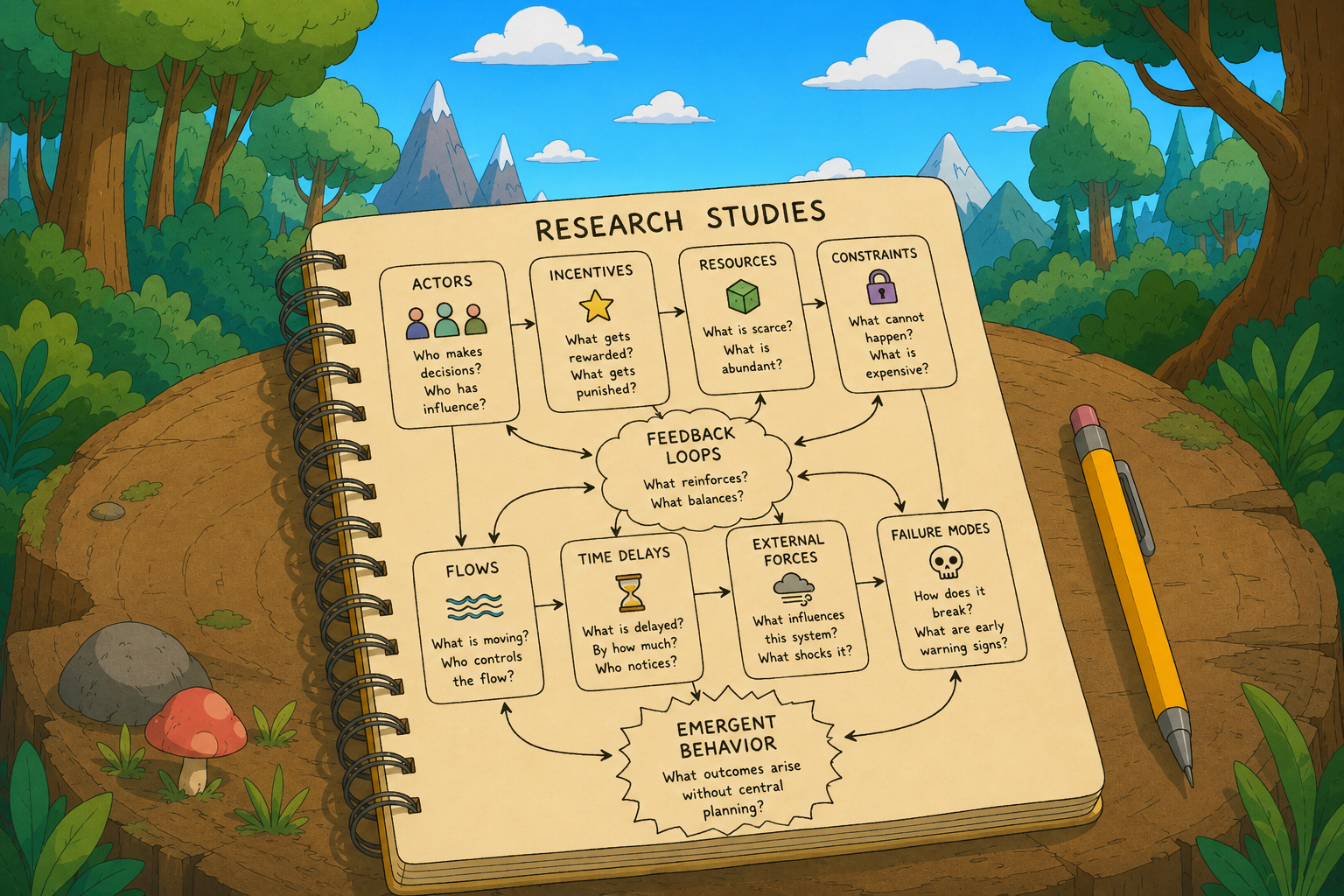
1. Actors
Identify decision-makers and influential participants.
Questions:
Who makes decisions?
Who has influence?
Who benefits?
Who bears costs?
Who is excluded?
Examples:
Individuals
Teams
Companies
Governments
Institutions
Algorithms
2. Incentives
Behavior follows incentives more reliably than stated intentions.
Questions:
What gets rewarded?
What gets punished?
What gets measured?
What gets funded?
What gets promoted?
Focus on actual incentives rather than stated goals.
3. Resources
Resources determine what is possible.
Examples:
Money
Time
Talent
Attention
Data
Political capital
Land
Energy
Questions:
What is scarce?
What is abundant?
Who controls access?
Where are the bottlenecks?
4. Constraints
Many outcomes are better explained by constraints than by intentions.
Examples:
Legal constraints
Technical constraints
Geographic constraints
Financial constraints
Organizational constraints
Human cognitive limitations
Questions:
What cannot happen?
What is expensive?
What is difficult?
What limitations shape behavior?
5. Flows
Everything important moves.
Examples:
Information
Money
Authority
Resources
Trust
Attention
Questions:
What is flowing?
Who controls the flow?
Where are the chokepoints?
Where does accumulation occur?
Where do losses occur?
6. Feedback Loops
Feedback loops determine growth, decline, stability, and collapse.
Reinforcing Loops
Output increases future output.
Example:
Good product
→ More users
→ More revenue
→ More investment
→ Better product
Balancing Loops
System self-corrects.
Example:
Traffic increases
→ Commutes worsen
→ Fewer trips occur
→ Traffic decreases
Questions:
What amplifies itself?
What stabilizes itself?
Which loop currently dominates?
7. Time Delays
Many systems operate on delayed feedback.
Examples:
Housing
Education
Climate
Infrastructure
Organizational change
Technical debt
Questions:
What effects are delayed?
How long is the delay?
Who notices the delay?
Who ignores it?
8. External Forces
No system exists independently.
Questions:
What larger systems influence this one?
What external shocks can affect outcomes?
What dependencies exist?
Examples:
Economic conditions
Technology shifts
Regulation
Demographics
Climate
9. Failure Modes
Every system has predictable failure patterns.
Questions:
How does this system degrade?
What causes collapse?
What are the early warning signs?
Examples:
Design systems:
Governance collapse
Component sprawl
Low adoption
Cities:
Fiscal crisis
Brain drain
Infrastructure decay
Organizations:
Incentive misalignment
Communication breakdown
Leadership instability
10. Emergent Behavior
Emergent outcomes occur without centralized planning.
Examples:
Traffic jams
Housing shortages
Bureaucracy
Design debt
Cultural trends
Research question:
If every actor is behaving rationally according to their incentives, why is the system producing this outcome?
This often reveals more than assigning blame to individual actors.
Research Workflow
Step 1
Observe a pattern. Do not try to explain it yet.
Step 2
List multiple possible explanations. Avoid attachment to any single theory.
Step 3
Gather evidence for and against each explanation.
Track both supporting and contradicting information.
Step 4
Map the system.
Actors.
Incentives.
Resources.
Constraints.
Flows.
Feedback loops.
Delays.
External forces.
Failure modes.
Step 5
Evaluate confidence. Avoid binary thinking.
Instead of evaluating for true or false, assign a low-med-high confidence score to possible explanations.
Step 6
Generate predictions. Ask yourself:
If this explanation is correct, what else should I observe?
Predictions are often more valuable than explanations.
Research Mindset
Think like a detective, not a lawyer.
Lawyers begin with conclusions and build cases.
Detectives begin with uncertainty and eliminate possibilities.
Useful phrases:
Interesting.
Possible.
Plausible.
Unclear.
Needs more evidence.
Low confidence.
Moderate confidence.
I don't know yet.
The objective is not certainty.
The objective is continuously improving the accuracy of the model.